Controlled charring – wood's natural protective mechanism
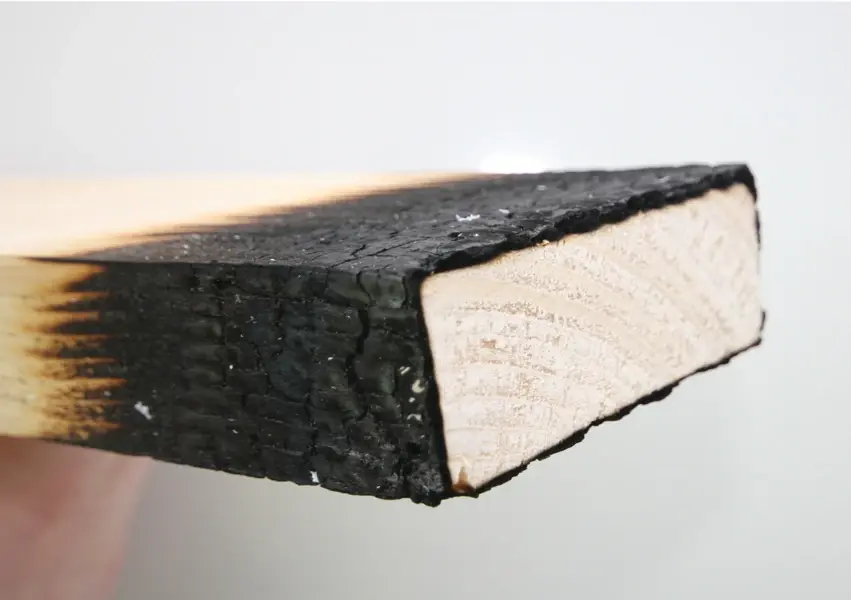
Woodsafe® enhances wood's natural protective mechanism by promoting controlled charring. The resulting char layer protects the underlying wood, limits fire development, and represents a functional fire protection mechanism—not a sign that the fire protection has failed.
Protection through controlled charring
Woodsafe® is based on a fundamental principle of fire science: enhancing wood's natural protective mechanism throughcontrolled charring. When wood is exposed to heat, it naturally begins to decompose through a process known as pyrolysis. In untreated wood, this process releases combustible pyrolysis gases that can ignite and contribute to continued fire growth.
Through Woodsafe's industrial fire-retardant treatment, this process is fundamentally modified. The fire-retardant chemicals integrated into the wood's cellular structure are activated by heat and promote thermal decomposition towards the rapid and stable formation of a protective char layer. At the same time, the generation of combustible pyrolysis gases is reduced, limiting heat release.
The resulting char layer acts as a natural thermal barrier. It insulates the underlying wood, slows heat transfer, and reduces the availability of fuel to the fire. The result is a slower and more controlled fire development, with delayed ignition, reduced flame spread, and lower heat release compared with untreated wood.
It is therefore important to understand that charring is not an indication that the fire protection has failed. On the contrary, the enhanced and stable formation of the char layer is an intended and verified protective mechanism. The char layer is an active component of the wood's fire resistance, helping to protect the structural timber during fire exposure.
Woodsafe® does not change the fact that wood is a combustible natural material. What it changes is how the wood behaves when exposed to fire. By influencing the wood's thermal decomposition, Woodsafe creates the conditions for more predictable fire behaviour and documented improvements in fire performance. This functionality is verified through standardized fire testing and classification in accordance with applicable European and international testing standards.

WOODSAFE® – Fire protection integrated into the wood's structure
A fundamental difference between industrial fire-retardant treatment and fire-retardant coatings lies in how the fire performance is achieved and verified.
Fire-retardant coatings are typically based on a surface-applied system that expands when exposed to fire, forming a thermally insulating protective layer on the surface of the wood. The verified fire performance is therefore dependent on the coating being applied, maintained, and used in accordance with the system documentation and associated instructions.
With industrial fire-retardant treatment, the fire-retardant chemicals are integrated into the wood's cellular structure through a controlled impregnation and fixation process. As a result, the fire performance becomes an integral part of the treated wood product within the scope of the tested and classified solution.
Both systems can provide high fire performance when used within their respective approved fields of application. It is therefore essential that the choice of system is always based on documented testing, classification, the intended service environment, and applicable regulations.
A clear and bold heading
Woodsafe®
Protection starts within the wood!
A clear and bold heading
Woodsafe® or Fire-Retardant Coatings – Two Different Technical Principles
When specifying fire-protected timber constructions, a particular fire classification is often required, for example Euroclass B-s1,d0 in accordance with EN 13501-1. Various fire protection systems are available to meet these requirements, and the appropriate solution depends on the building design, intended application, substrate, and project-specific conditions.
Fire-retardant coatings are based on a surface-applied system that enhances the fire performance of wood by forming a protective coating. The verified fire performance is linked to the applied coating and is valid only for the substrates, coating thicknesses, and construction assemblies covered by the system's testing and classification.
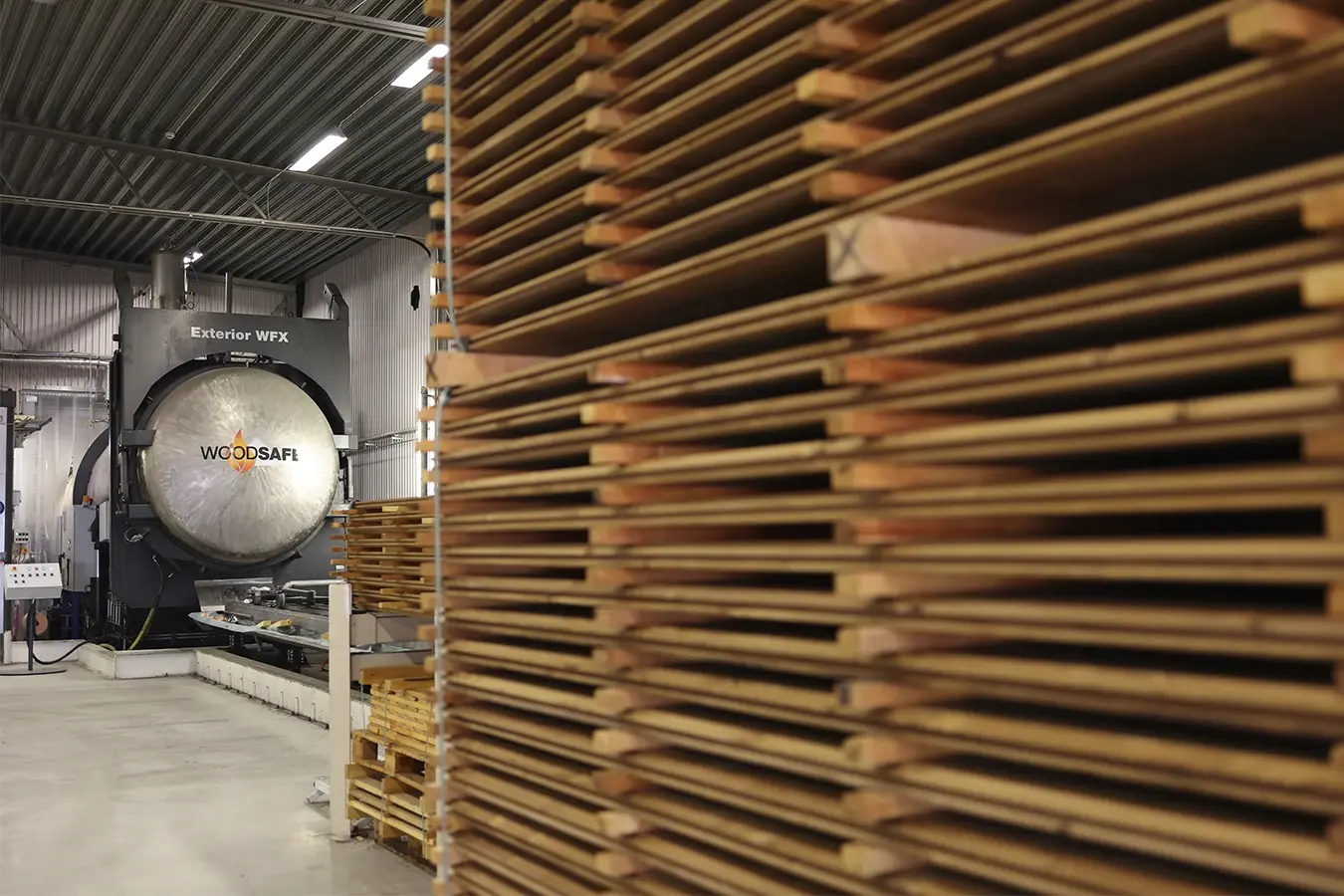
Woodsafe®, on the other hand, is based on an industrial vacuum-pressure impregnation process in which the fire-retardant chemicals are integrated into the wood's cellular structure through a controlled impregnation and fixation process. The product's fire classification, together with any Type Approvals or CE documentation, is based on the timber species, dimensions, and construction assemblies that have been tested and certified.
Both systems can meet demanding fire performance requirements when used within their verified fields of application. It is therefore essential to select a solution that has been documented, tested, and classified for the intended application, and to ensure that it is used in accordance with the applicable documentation and the manufacturer's instructions.
Woodsafe®
Woodsafe®
-
Each type of wood has a verified fire class
-
The wood itself constitutes fire protection B-s1, d0, (s2), SP FIRE 105, K210/B-s1,d0
-
Does not form a film coating
-
Preserves structure, feel and shade
-
Suitable for harsh environments, e.g. corridors, gyms, sports halls
Fire protection paint, varnish
-
Fire protection paint, -varnish is film-forming
-
The wood is still D-s2,d0
-
Affects structure, feel and shade
-
Sensitive to the natural movement of the wood
-
Sensitive to wear and tear
-
On-site execution not equivalent certification