
Consultant
Here you'll find useful information for consultants in various fields. Click the buttons below to learn more.
Fire Class in Practice
A fire class describes how a material behaves in a fire under defined test conditions. To be relevant in practice, the class must be properly verified and applied to the specific application.
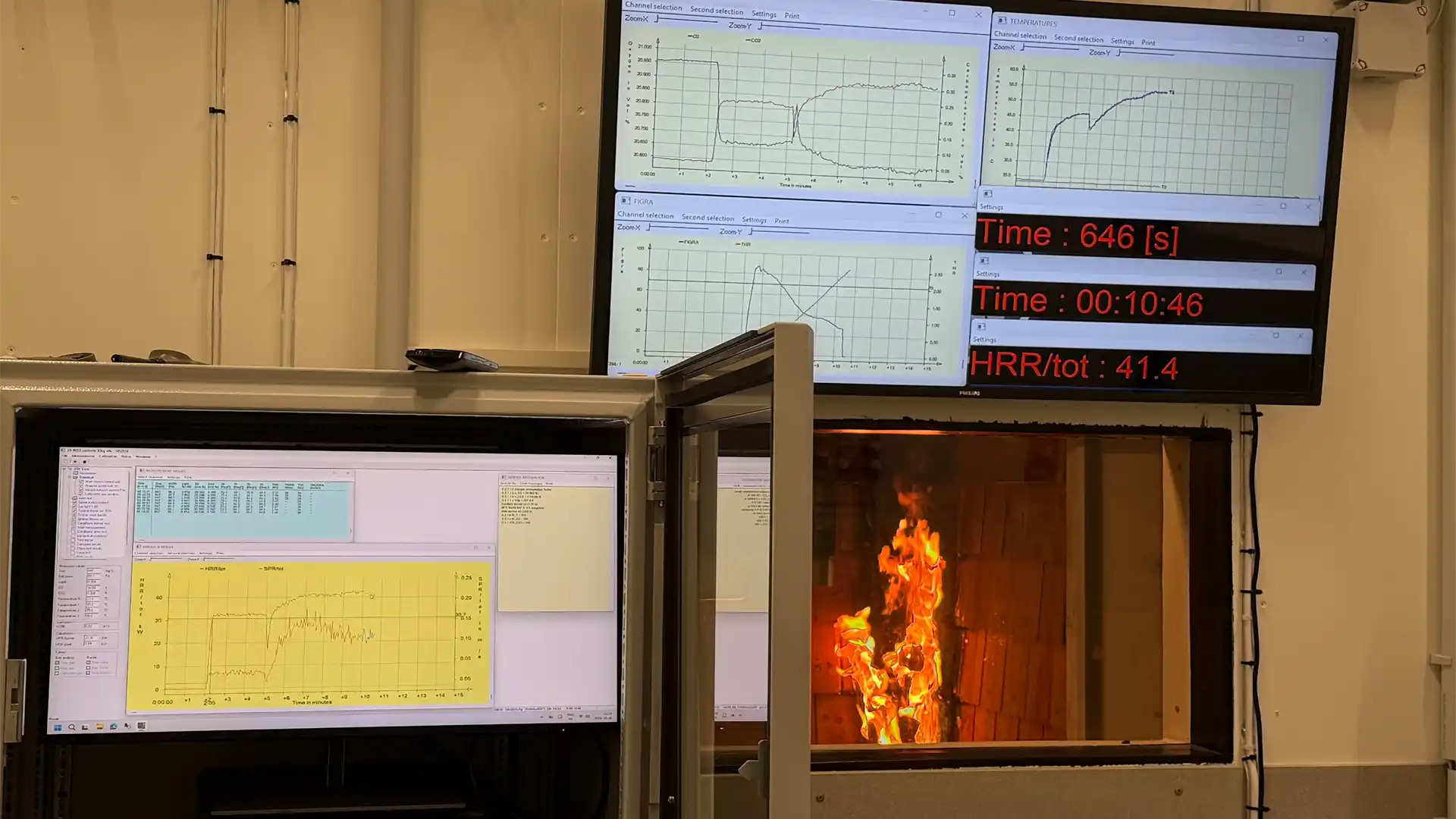
A key parameter is the FIGRA (Fire Growth Rate Index), which describes how quickly a fire spreads over time. A low FIGRA value indicates limited fire growth and is key to achieving a high fire class. FIGRA often carries more weight than individual peak values, as it reflects the dynamics of the fire’s progression. In addition to FIGRA, other factors evaluated include total heat release (THR₆₀₀s), smoke development (s-class), and the presence of burning droplets (d-class).
The result is influenced by the product’s construction, surface treatment, and installation method, which means that fire class is a system property, not merely a material property. For fire-retardant treated wood, proper testing and correct application are crucial for the declared fire class to be technically and legally relevant.
Field of Application (EXAP)
A fire class rating is valid only under the tested and documented conditions.
A fire class rating is valid only under the tested and documented conditions. Any use outside these parameters is invalid and may not be relied upon in design or construction.
The Field of Application (FoA/EXAP) specifies exactly what has been tested and approved within a Euroclass, including wood species, density, dimensions, panel design, installation method, and underlying substrate. Euroclass according to EN 13501-1 is applicable only within these specified parameters.
Woodsafe has conducted extensive testing on several wood species and structural solutions, providing access to clearly defined FoA documents tailored for design, technical specifications, and fire protection documentation.
For consultants, it is crucial to always verify the FoA before citing a Euroclass in documents. Without a correct FoA, the classification lacks legal and technical validity and cannot serve as the basis for regulatory requirements or the allocation of responsibility.
Traceable and Verifiable Performance
From raw materials to certificates—every step is traceable, verifiable, and documented.
Woodsafe bases its documentation on a traceable process, in which every step is tracked within our quality system (WQS), which is certified by a third party and a notified body.
- 1Project Registration
Supplier, wood species, weight, density, etc., are recorded and linked to the relevant order in the quality management system. - 2Sampling
Input data and materials are monitored through sampling conducted by a notified body. - 3All data is openly shared with the notified body
Samples are acclimatized and sectioned prior to type testing to ensure representative sampling. - 4Type Testing
Performed by an accredited laboratory, RISE (0402), in accordance with EN 13823 and EN ISO 11925-2.
- 5Classification
A classification report is issued based on test results and the associated FoA. - 6CE certificates are issued by a notified certification body
Following a review of test results, the Declaration of Conformity (FoA), and manufacturing controls in accordance with applicable regulations. - 7Declaration of Performance (DoP)
Issued following established CE certification and based on verified test results, FoA, and manufacturing control. - 8Certified Processes
In accordance with ISO 9001:2015 and WQS 2.0, audited by a notified body and subject to ongoing third-party monitoring.
CE Marking and Documented Systems
We were CE-certified four years before CE certification became a mandatory legal requirement under the EU regulation.
Woodsafe was the first in Europe to offer CE-marked fire-retardant wood products in accordance with EN 14915, several years before CPR 305/2011 took effect. For consultants, this means that all of our products can be referenced in valid Declarations of Performance (DoPs) and certificates.
Some examples of variations between different types of wood and FoA: (HT = Heat-Treated wood)
| Thickness (mm) | Design | FIGRA (W/s) | THR (MJ) | TSP | Air gap | |
|---|---|---|---|---|---|---|
| Ash - HT | 19.5 | Closed panel (V) | 44 | 3.0 | 26 | Yes |
| Ayous - HT | 18 | Spaced/open panel (V) | 96 | 4.3 | 74 | YES |
| Radiata Pine - HT | 21 | Closed panel (V) | 72 | 3.7 | 50 | Yes |
| Pine - HT | 19.5 | Closed panel (V) | 72 | 2.8 | 50 | Yes |
| Spruce | 12 | Closed panel (H) | 72 | 6.0 | 36 | Yes |
| Accoya | 22 | Sparse/Open (V) | 83 | 5.5 | 46 | Yes |
| Birch | 12 | Closed panel (V) | 52 | 2.6 | 37 | Yes |